

Audrey Woods, MIT CSAIL Alliances | March 23, 2026
She’s never used a pair of knitting needles, but MIT CSAIL Assistant Professor Mariana Popescu is pioneering a new vision for architecture with knitting. Working at the intersection of digital fabrication, structural engineering, and computational design, Professor Popescu is making construction more adaptable, transportable, efficient, and sustainable one stitch at a time.
FROM CODE TO CONSTRUCTION
Professor Popescu’s research path began with a fascination for lightweight materials and fabrication techniques. During her early studies, she worked with fiber composites and other advanced materials, raising the question: how can we build structures that achieve the same performance with dramatically less material? This led her to explore fabric formwork, which “has had a tradition for a while but never ended up being the mainstream way of building things.” At the time, knitting was one of the most dismissed of the fabric options because it’s not as strong, very compliant and deformable, and has a behaviour difficult to understand, model, or predict. Professor Popescu, however, saw an opportunity.
"I think knitting was a good teaser for me because it not only offered a technique, but it's incredibly mathematical and computable... it's based quite a lot on coding logics".
Her research now focuses on using knitted textiles as a flexible formwork for concrete, other materials, or even as deployable structures themselves. With Professor Popescu’s method, industrial knitting machines create custom fabric of theoretically infinite length with precisely programmed properties–material, stitch pattern, texture density–that dictate behavior. The resulting textile is then tensioned in a rig, shaped into the desired geometry, and coated in layers of cement or another stiffening material. The knitted formworks Professor Popescu creates are a kind of metamaterial because mechanical and geometric properties can be embedded in a single manufacturing step without any assembly or post-processing. This "File to Factory" pipeline (now called “digital fabrication”) allows for the creation of structurally efficient and adaptable geometries that use significantly less material than traditional construction methods, making the process lightweight, efficient, and flexible both literally and figuratively.
BRIDGING ARCHITECTURE, COMPUTATION, AND DESIGN
The real-world impact of her work is already visible. At the 2025 Venice Architecture Biennale, she and her team created Necto, a 100-square-meter textile structure inside the Corderie in Venice, Italy. The Necto installation demonstrated advanced material intelligence by aligning the fabrication design with principle stress lines, offering reinforcement exactly where the structure feels the most tension by matching the knitting pattern to the natural flow of force. To ensure the project was eco-friendly and embodying principles of circularity, it was designed to be nearly fully biodegradable and included a "material passport" in its bio-based coating, a piece of synthetic DNA developed in collaboration with colleagues from the Shaping Matter Lab at TU Delft which stores the instructions needed to identify, trace, possibly recycle, and even rebuild the structure in the future.
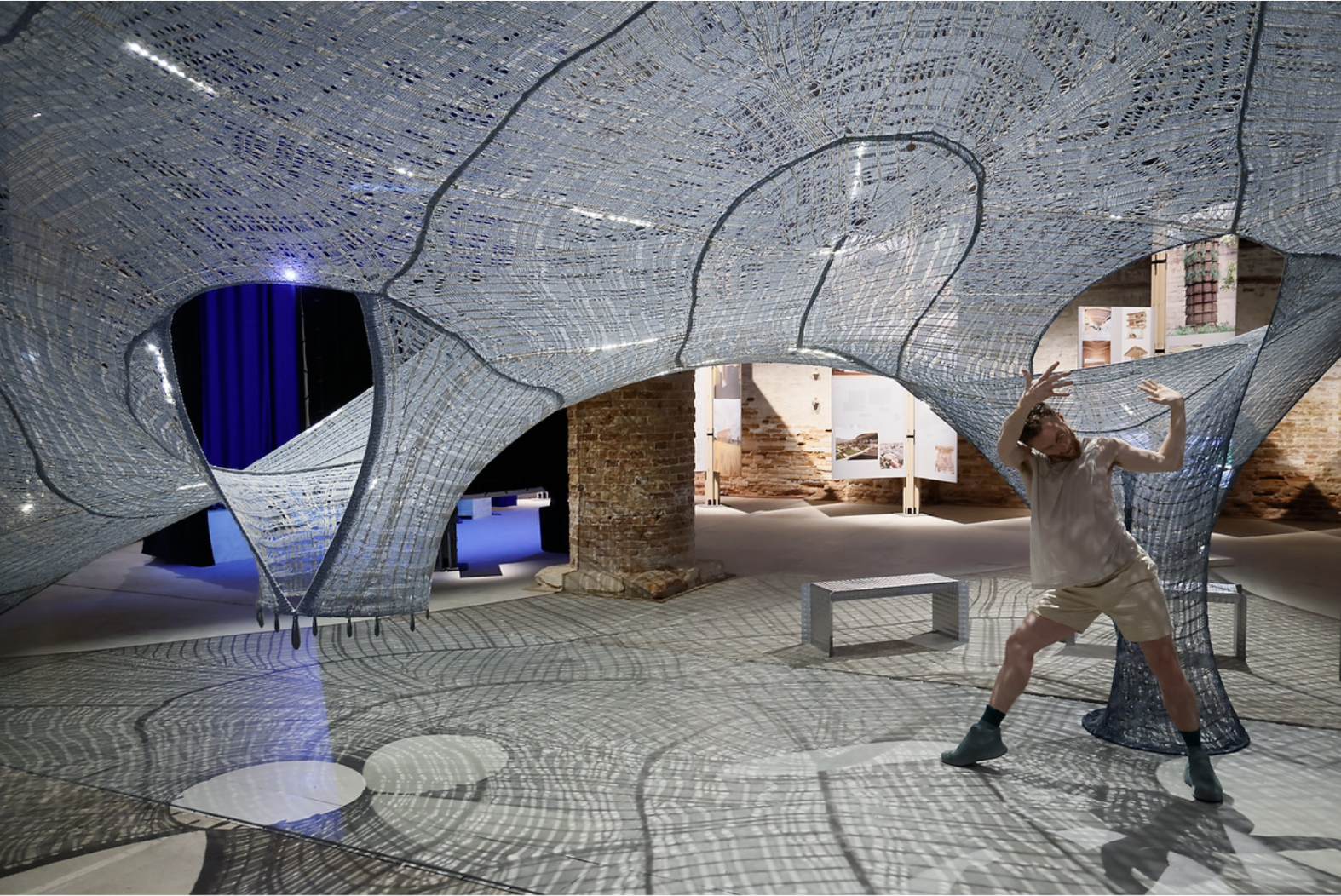
Riley Watts performing under Necto at the 19th International Architecture Exhibition in Venice (project by: Solid Objectives Idenburg Liu (SO-IL), Mariana Popescu, TheGreenEyl)
The installation was notable not just for its innovative design process, but also for being permitted to clamp directly onto the ancient pillars of the building, whose centuries-old plaster is so fragile that it would crack under most loads. Professor Popescu and her team were able to demonstrate that their structure’s near-negligible weight and provably low forces worked within the historic building’s restraints. At the conclusion of the Biennale, the entire installation packed down to a 50-kilo duffel bag which was shipped to MIT.
To see another example of Professor Popescu’s work in the wild, one could visit KnitCandela in Mexico City, a demo she made while finishing her PhD at the Block Research Group in ETH Zürich. This project showcased the viability of building complex, curvaceous concrete structures with an ultra-lightweight knitted formwork, replacing heavy, wasteful timber molds with fabric that she carried from Switzerland to Mexico in her suitcase.
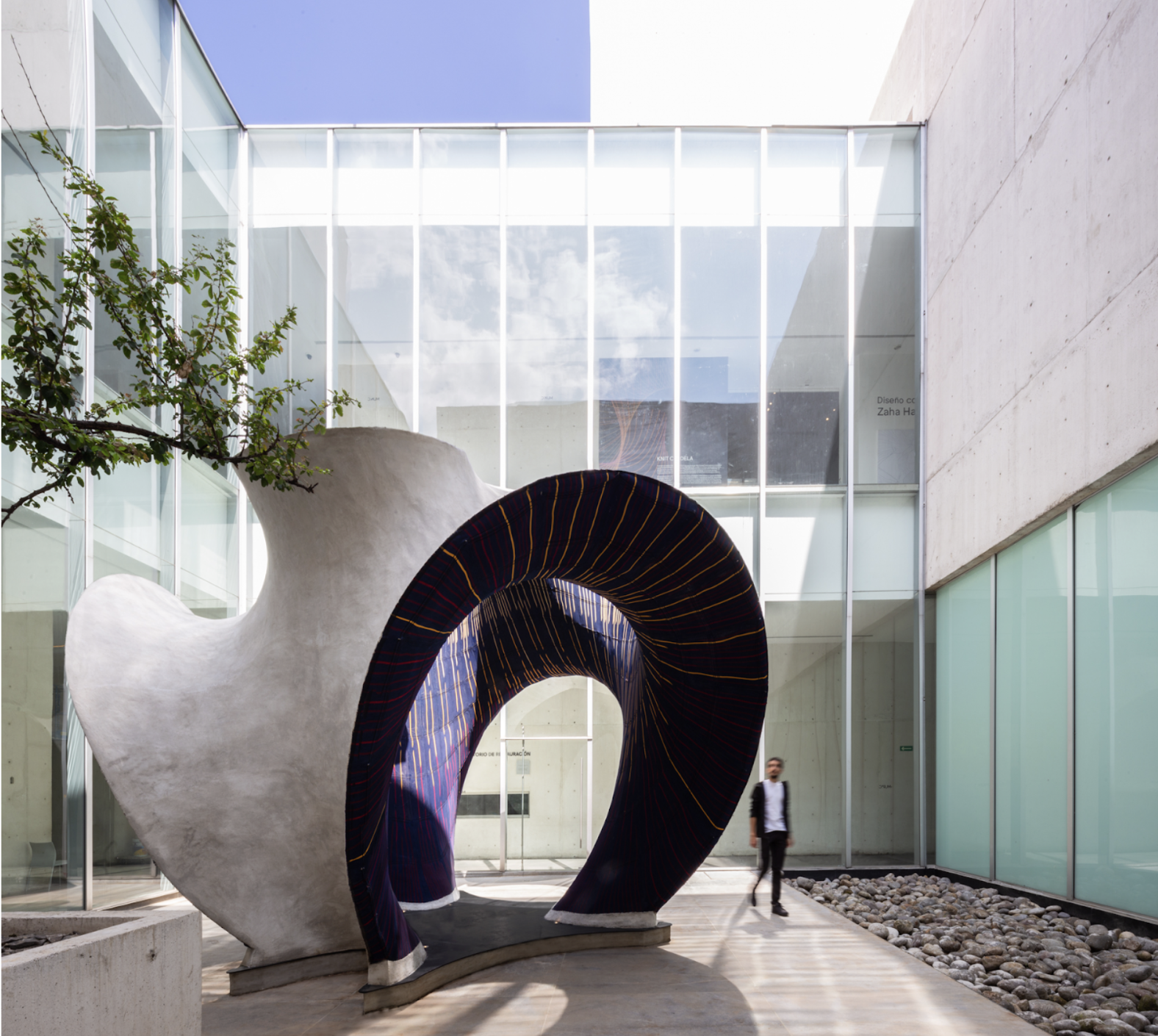
KnitCandela at MUAC (photo: Angelica Ibarra)
Professor Popescu also collaborated with colleagues at the Technical University of Munich and TU Braunschweig to prototype a knitted textile footbridge constructed using robotic spray application of concrete in a prefabricated setting. This project highlights how automation can be incorporated at scale as well as the new types of design made possible using knit textiles. After the success of this prototype, she's on the lookout for even bigger opportunities to test out her ideas. “If you see a possibility for me to build a bridge, I am happy to. That’s on my bucket list.”
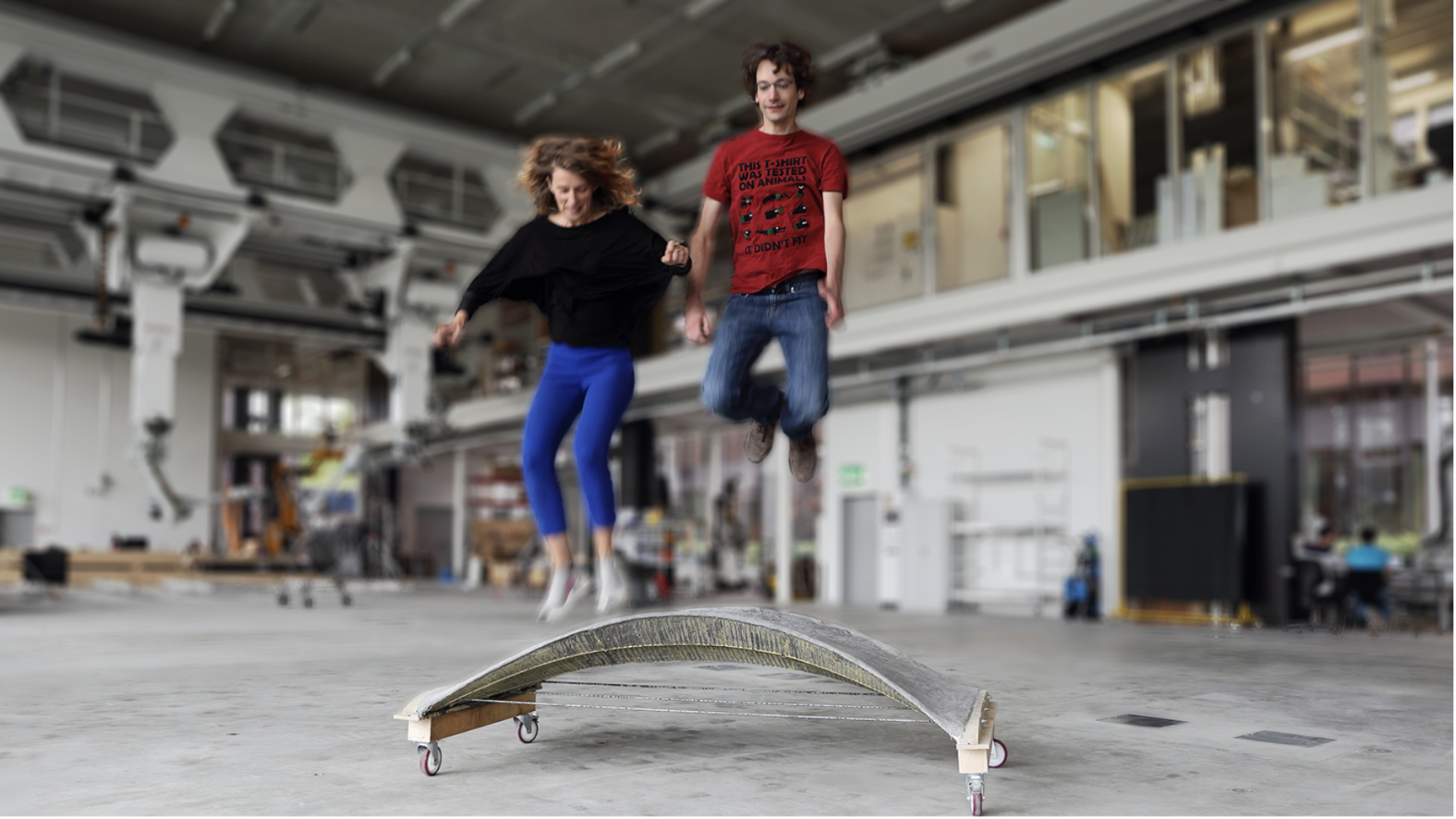
KnitBridge 2017 (photo: Pieter Bieghs)
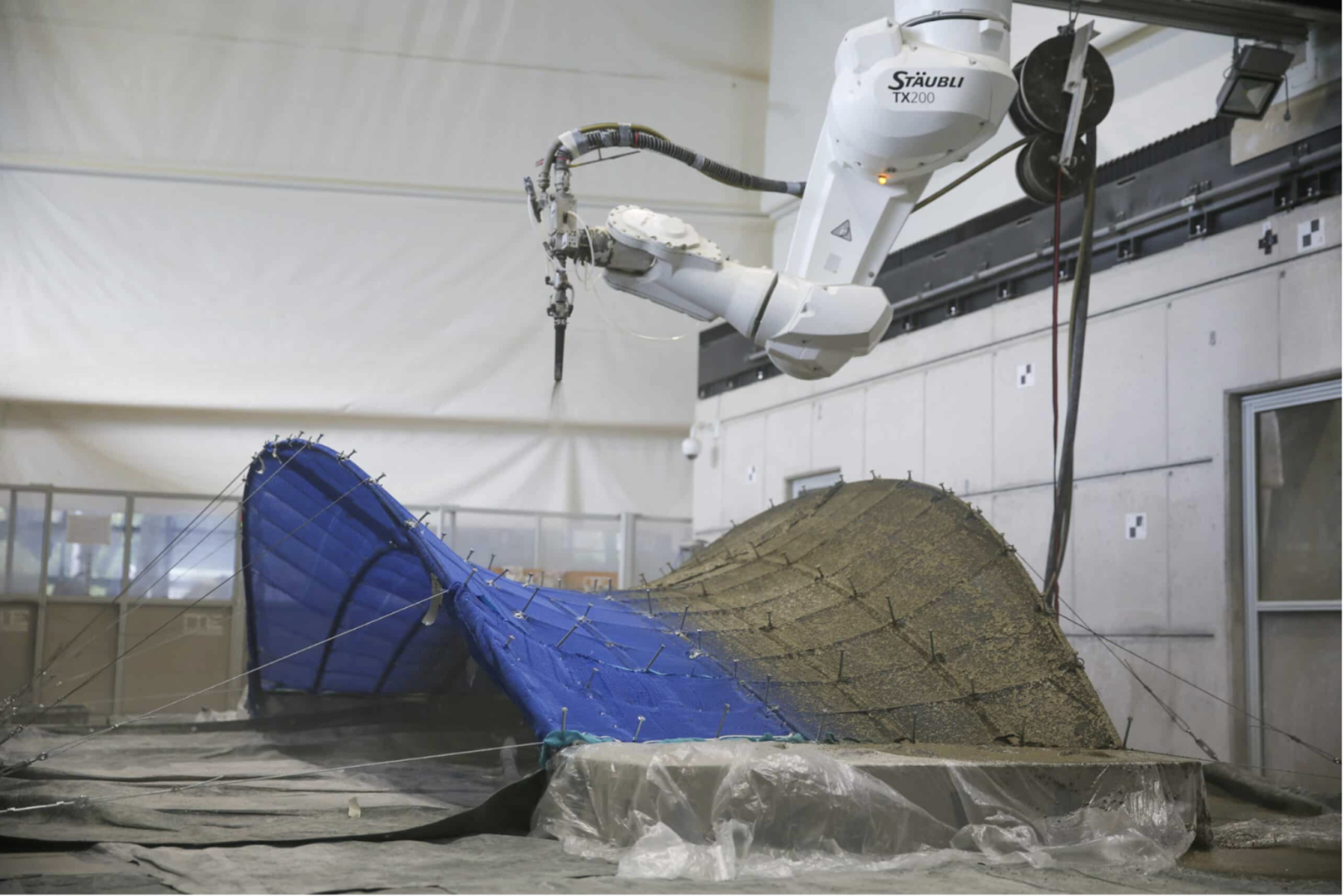
KnitCrete Bridge 2022 (photo: TUBS ITE)
Prior to joining EECS and the Department of Architecture at MIT, Professor Popescu has been internationally celebrated for her novel work. She and her colleagues won a prestigious grant from the European Innovation Council (EIC) Pathfinder program for FlexiForm, an ongoing project that integrates computational design and digital fabrication to create sustainable, materially efficient concrete structures using flexible formwork. In 2019, Professor Popescu was named one of MIT Technology Review’s "35 Innovators Under 35.” Working with known architects and institutions—such as Zaha Hadid for KnitCandela and SO-II architects for Necto—Professor Popescu is developing and testing the principles of her work hand-in-hand with industry to ensure maximum viability and real-world impact.
MESSAGE TO INDUSTRY & FUTURE WORK
Professor Popescu’s research addresses several of the most pressing challenges in modern construction, including sustainability, material efficiency, and logistical bottlenecks. Her textile designs offer opportunities to dramatically reduce concrete and single-use frameworks, operate in unusual or difficult-to-reach locations, and enable a pipeline suited to automation and AI assistance. In future work Professor Popescu imagines using AI to design the fabric based on a given set of parameters. “Ideally, what I would like to do is say: I want to get to this geometry. What distribution of properties should I have?” Developing computational tools to translate three-dimensional geometries into machine code for knitting will accelerate the process and allow it to work at the scale and resolution needed for industry construction.
Generally, Professor Popescu believes fabrication and design should be much more integrated. The current pipeline separates architect, engineer, and contractor, leading to bottlenecks and expensive miscommunications. By using the fabrication technique to inform design from the beginning, Professor Popescu’s technique offers an alternative and more cohesive approach.
But her ideas are not limited to architecture. Professor Popescu is also exploring even more imaginative uses for industrial knit textiles, like shoreline control or anti-erosion measures. The ability to encode material properties at such a precise level—down to a single fabric loop—offers expansive and exciting possibilities. Overall, she would “really love it if these types of techniques get adopted more, and that changes the way we build things.”
Learn more about Professor Popescu’s on her website or CSAIL page.