Image
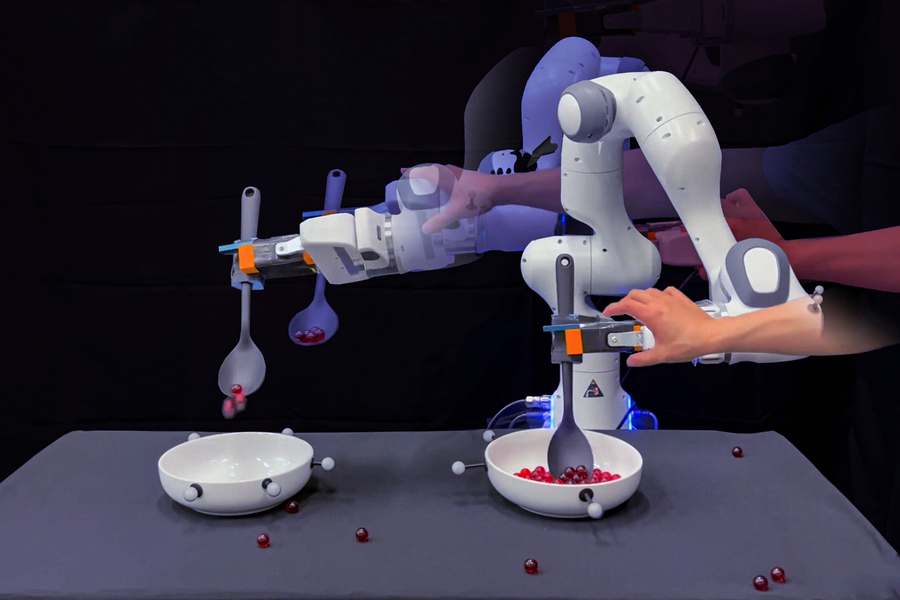
alt="Adaptive smart glove from MIT CSAIL researchers can send tactile feedback to teach users new skills, guide robots with more precise manipulation."
CSAIL article

You’ve likely met someone who identifies as a visual or auditory learner, but others absorb knowledge through a different modality: touch. Being able to understand tactile interactions is especially important for tasks such as learning delicate surgeries and playing musical instruments, but unlike video and audio, touch is difficult to record and transfer.

Image
alt="MIT CSAIL's AI system melds simulations and physical testing to forge materials with newfound durability and flexibility for diverse engineering applications."
CSAIL article

Every time you smoothly drive from point A to point B, you're not just enjoying the convenience of your car, but also the sophisticated engineering that makes it safe and reliable. Beyond its comfort and protective features lies a lesser-known yet crucial aspect: the expertly optimized mechanical performance of microstructured materials. These materials, integral yet often unacknowledged, are what fortify your vehicle, ensuring durability and strength on every journey. 

Image
alt="New MIT research provides a theoretical proof for a phenomenon observed in practice: that encoding symmetries in the machine learning model helps the model learn with fewer data (Credits: Alex Shipps/MIT CSAIL)."
CSAIL article

Behrooz Tahmasebi — an MIT PhD student in the Department of Electrical Engineering and Computer Science (EECS) and an affiliate of the Computer Science and Artificial Intelligence Laboratory (CSAIL) — was taking a mathematics course on differential equations in late 2021 when a glimmer of inspiration struck.

Image
alt="MIT team developed two machine-learning models for early detection of pancreatic ductal adenocarcinoma (PDAC), the most common form of the cancer. To access a broad and diverse database, the team synced up with a federated network company, using Electronic Health Record (EHR) data from various institutions across the US (Credits: Sudarsan Thobias/Shutterstock and Alex Shipps/MIT CSAIL)."
CSAIL article

The first documented case of pancreatic cancer dates back to the 18th century. Since then, researchers have undertaken a protracted and challenging odyssey to understand the elusive and deadly disease. To date, there is no better cancer treatment than early intervention. Unfortunately, the pancreas, nestled deep within the abdomen, is particularly elusive for early detection.