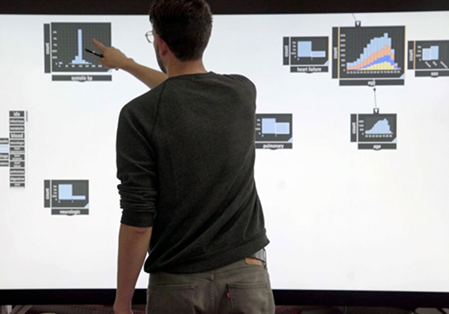
In the Iron Man movies, Tony Stark uses a holographic computer to project 3D data into thin air, manipulate them with his hands, and find fixes to his superhero troubles. In the same vein, researchers from MIT and Brown University have now developed a system for interactive data analytics that runs on touchscreens and lets everyone — not just billionaire tech geniuses — tackle real-world issues.
Dina Katabi,the Andrew and Erna Viterbi Professor of Electrical Engineering and Computer Science, has been named as aGreat Immigrantby the Carnegie Corporation of New York. Katabi, who was born in Syria, is among 38 naturalized citizens from 35 countries of origin who are being celebrated for their contributions to American society.
Over the past year MIT CSAIL has worked with Novartis to test a novel technology for passive, contactless monitoring of physiological signals that may be used to monitor clinical trial patients in their homes.
Robots that have been programmed to see or feel can’t use these signals quite as interchangeably. To better bridge this sensory gap, researchers from MIT’s Computer Science and Artificial Intelligence Laboratory (CSAIL) have come up with a predictive artificial intelligence (AI) that can learn to see by touching, and learn to feel by seeing.
Technology as a vector for positive change | Technology for a better world
CSAIL recently established the TEDxMIT series. The TEDxMIT events will feature talks about important and impactful ideas by members of the broader MIT community.
This event is organized by Daniela Rus and John Werner, in collaboration with a team of undergraduate students led by Stephanie Fu and Rucha Keklar.
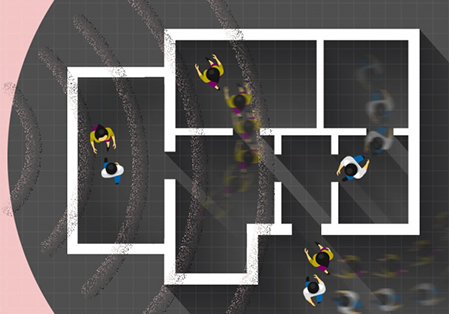
We live in a world of wireless signals flowing around us and bouncing off our bodies. MIT researchers are now leveraging those signal reflections to provide scientists and caregivers with valuable insights into people’s behavior and health.
MIT CSAIL unsealed a special time capsule from 1999 after a self-taught programmer Belgium solved a puzzle devised by MIT professor and famed cryptographer Ron Rivest.