Image
Ryan Williams headshot
CSAIL article

The European Association for Theoretical Computer Science (EATCS) recently awarded Ryan Williams, MIT EECS professor and CSAIL member, with the 2024 Gödel Prize for his 2011 paper, “Non-Uniform ACC Circuit Lower Bounds.” Williams receives this honor for presenting a novel paradigm for a “rich two-way connection" between algorithmic techniques and lower-bound methods.

Image
alt="MIT researchers’ "consensus game" is a game-theoretic approach for language model decoding. The equilibrium-ranking algorithm harmonizes generative and discriminative querying to enhance prediction accuracy across various tasks, outperforming larger models and demonstrating the potential of game theory in improving language model consistency and truthfulness (Credits: Alex Shipps/MIT CSAIL)."
CSAIL article

Imagine you and a friend are playing a game where your goal is to communicate secret messages to each other using only cryptic sentences. Your friend's job is to guess the secret message behind your sentences. Sometimes, you give clues directly, and other times, your friend has to guess the message by asking yes-or-no questions about the clues you've given. The challenge is that both of you want to make sure you're understanding each other correctly and agreeing on the secret message.

Image
Using machine learning, MIT CSAIL and Project CETI researchers revealed complex, language-like structure in sperm whale communication with context-sensitive and combinatorial elements (Credits: Alex Shipps/MIT CSAIL).
CSAIL article

The allure of whales has stoked human consciousness for millennia, casting these ocean giants as enigmatic residents of the deep seas. From the biblical Leviathan to Herman Melville's formidable Moby Dick, whales have been central to mythologies and folklore. And while cetology, or whale science, has improved our knowledge of these marine mammals in the past century in particular, studying whales has remained a formidable a challenge.

Image
Three new frameworks from MIT CSAIL reveal how natural language can provide important context for language models that perform coding, AI planning, and robotics tasks (Credit: Alex Shipps/MIT CSAIL, with components from the researchers and Pixabay).
CSAIL article

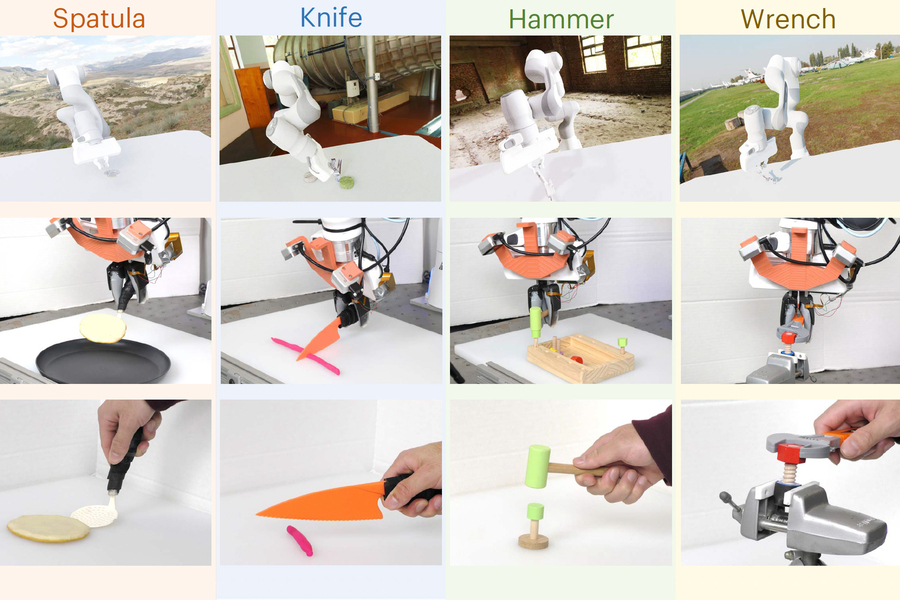
Large language models (LLMs) are becoming increasingly useful for programming and robotics tasks, but for more complicated reasoning problems, the gap between these systems and humans looms large. Without the ability to learn new concepts like humans do, these systems fail to form good abstractions — essentially, high-level representations of complex concepts that skip less-important details — and thus sputter when asked to do more sophisticated tasks.

Image
alt="A team of MIT researchers found highly memorable images have stronger and sustained responses in ventro-occipital brain cortices, peaking at around 300ms. Conceptually similar but easily forgettable images quickly fade away (Credits: Alex Shipps/MIT CSAIL)."
CSAIL article

For nearly a decade, a team of MIT Computer Science and Artificial Intelligence Laboratory (CSAIL) researchers have been seeking to uncover why certain images persist in a people's minds, while many others fade. To do this, they set out to map the spatio-temporal brain dynamics involved in recognizing a visual image. And now for the first time, scientists harnessed the combined strengths of magnetoencephalography (MEG), which captures the timing of brain activity, and functional magnetic resonance imaging (fMRI), which identifies active brain regions, to precisely determine when and where the brain processes a memorable image.