A group led by researchers at MIT’s Computer Science and Artificial Intelligence Lab (CSAIL) has developed a machine learning model that can look at an X-ray to quantify how severe the edema is, on a four-level scale ranging from 0 (healthy) to 3 (very, very bad). The system determined the right level more than half of the time, and correctly diagnosed level 3 cases 90 percent of the time.
MIT researchers have developed a wireless, private way to monitor a person’s sleep postures — whether snoozing on their back, stomach, or sides — using reflected radio signals from a small device mounted on a bedroom wall.
Launched in May, Covid Controls was developed by a team who met while working at the Singapore-MIT Alliance for Research & Technology (SMART), a research center created in 2007 by the Massachusetts Institute of Technology in partnership with the National Research Foundation of Singapore.
MIT CSAIL and STEMM Global Scientific Community announced that they will gather thought leaders from all over the world at a virtual summit dedicated to AI in Healthcare on October 1-2, 2020. The aim of the summit is to boost effective collaboration among leading AI academics, healthcare experts and business leaders to support innovation in healthcare.
CSAIL will be launching a new initiative focused on machine learning applications. MachineLearningApplications@CSAIL, or “MLA@CSAIL”, will focus on current challenges in machine learning to prepare industry members for digital transformation in their workplaces.
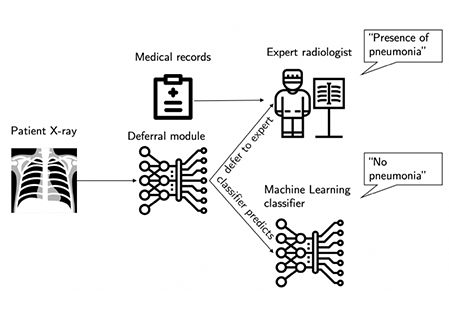
Researchers from CSAIL have developed a machine learning system that can either make a prediction about a task, or defer the decision to an expert. Most importantly, it can adapt when and how often it defers to its human collaborator, based on factors such as its teammate’s availability and level of experience.
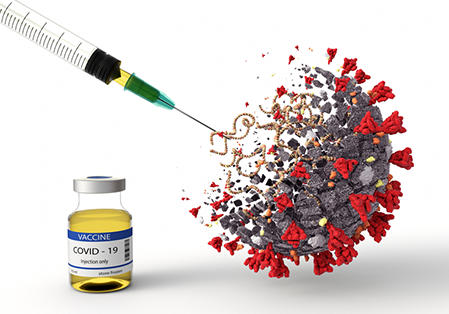
Recently, a team of researchers from MIT’s Computer Science and Artificial Intelligence Laboratory (CSAIL) took a new approach to getting us closer to a solution: a combinatorial machine learning system that selects peptides (short strings of amino acids) that are predicted to provide high population coverage for a vaccine.
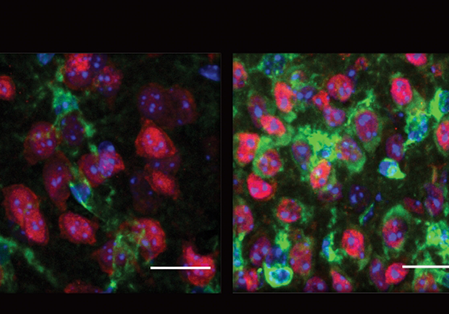
In the first study to comprehensively track how different types of brain cells respond to the mutation that causes Huntington’s disease (HD), MIT neuroscientists found that a significant cause of death for an especially afflicted kind of neuron might be an immune response to genetic material errantly released by mitochondria, the cellular components that provide cells with energy.
Regina Barzilay, the Delta Electronics Professor in the Department of Electrical Engineering and Computer Science, and Tommi Jaakkola, the Thomas Siebel Professor of Electrical Engineering and Computer Science, join Ziv Bar-Joseph from Carnegie Mellon University for a project using machine learning to seek treatment for Covid-19.
Attendees joined CSAIL Alliances for the launch of our newest research initiative, MachineLearningApplications@CSAIL. Many companies are unsure of how, where, or if they should leverage Machine Learning (ML). Awash in data, they are looking to turn that data into intelligence that drives increasingly efficient processes.