

Filter Options
Filter Options



Category
Graphic & Vision
Language
Python
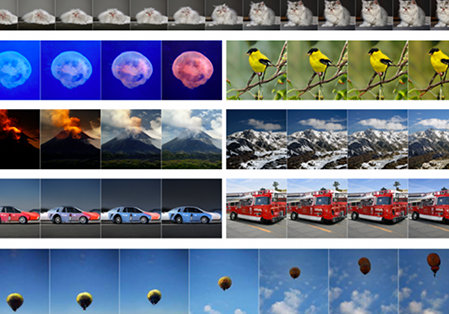
Given a grayscale photograph as input, this paper attacks the problem of hallucinating a plausible color version of the photograph. This problem is clearly underconstrained, so previous approaches have either relied on significant user interaction or resulted in desaturated colorizations. We propose a fully automatic approach that produces vibrant and realistic colorizations. We embrace the underlying uncertainty of the problem by posing it as a classification task and use class-rebalancing at training time to increase the diversity of colors in the result.
BSD License
Last Updated
Category
Graphic & Vision
Language
JSON
Lyra is an interactive environment that enables custom visualization design without writing any code. Graphical “marks” can be bound to data fields using property drop zones; dynamically positioned using connectors; and directly moved, rotated, and resized using handles. Lyra also provides a data pipeline interface for iterative visual specification of data transformations and layout algorithms. Lyra is more expressive than interactive systems like Tableau, allowing designers to create custom visualizations comparable to hand-coded visualizations built with D3 or Processing.
University of Washington Interactive Data Lab
Last Updated
Category
Graphic & Vision
Language
JSON
Vega-Lite is a high-level grammar of interactive graphics. It provides a concise JSON syntax for rapidly generating visualizations to support analysis. Vega-Lite specifications can be compiled to Vega specifications.
University of Washington Interactive Data Lab
Last Updated

Category
Graphic & Vision
Understanding where people are looking is an informative social cue. In this work, we present Gaze360, a large-scale gaze-tracking dataset and method for robust 3D gaze estimation in unconstrained images. Our dataset consists of 238 subjects in indoor and outdoor environments with labeled 3D gaze across a wide range of head poses and distances. It is the largest publicly available dataset of its kind by both subject and variety, made possible by a simple and efficient collection method.
Last Updated