A recent study from Oregon State University estimated that more than 3,500 animal species are at risk of extinction because of factors including habitat alterations, natural resources being overexploited, and climate change.
In part 2 of our two-part series on generative artificial intelligence’s environmental impacts, MIT News explores some of the ways experts are working to reduce the technology’s carbon footprint.
The Quant-essential Qualities: Insider Insights for Thriving in Algorithmic Trading
Abstract: The world of quantitative trading is notoriously siloed, secretive, and intensely competitive. In this talk, Hanna and Dan will offer an insider's perspective on quant trading, sharing insights from our firm, and outline the key qualities you can cultivate to excel in the industry.
CSAIL Alliances & FinTechAI@CSAIL Board Member Royal Bank of Canada (RBC) Borealis AI Group will be at CSAIL on 9/22 in Kiva to deliver a technical talk from Dr. Greg Mori as well as connect with interested students for job opportunities.
Talk Title: Foundation Model Challenges and Opportunities in Financial Services
Monday 9/22 in Kiva 32-G449 12-1pm EST. Food will be served so please register for accurate food order!
3D printing has come a long way since its invention in 1983 by Chuck Hull, who pioneered stereolithography, a technique that solidifies liquid resin into solid objects using ultraviolet lasers. Over the decades, 3D printers have evolved from experimental curiosities into tools capable of producing everything from custom prosthetics to complex food designs, architectural models, and even functioning human organs.
If you rotate an image of a molecular structure, a human can tell the rotated image is still the same molecule, but a machine-learning model might think it is a new data point. In computer science parlance, the molecule is “symmetric,” meaning the fundamental structure of that molecule remains the same if it undergoes certain transformations, like rotation.
CSAIL Alliances is excited to recognize Dr. Luis Muniz of Bayer as the recipient of the 2025 CSAIL Alliances Connector Award. As Bayer’s Director of Global IT External Partnerships, Dr. Muniz exemplifies what it means to be a Connector: a bridge-builder and strategic thinker who brings people together for real, measurable impact.
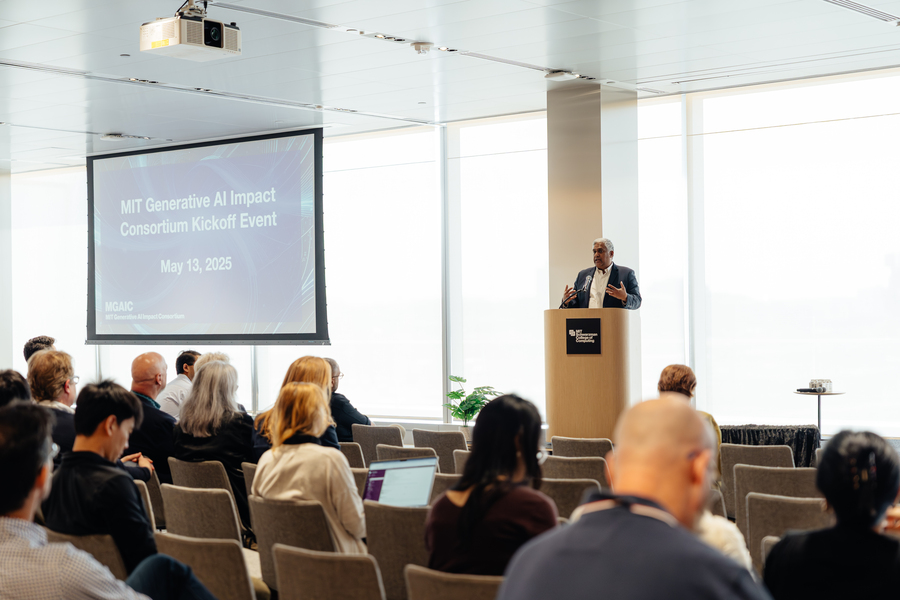
Launched in February of this year, the MIT Generative AI Impact Consortium (MGAIC), a presidential initiative led by MIT’s Office of Innovation and Strategy and administered by the MIT Stephen A. Schwarzman College of Computing, issued a call for proposals, inviting researchers from across MIT to submit ideas for innovative projects studying high-impact uses of generative AI models.
When the Venice Biennale’s 19th International Architecture Exhibition launches on May 10, its guiding theme will be applying nimble, flexible intelligence to a demanding world — an ongoing focus of its curator, MIT faculty member Carlo Ratti.
As a college student in Serbia with a passion for math and physics, Ana Trišović found herself drawn to computer science and its practical, problem-solving approaches. It was then that she discovered MIT OpenCourseWare, part of MIT Open Learning, and decided to study a course on Data Analytics with Python in 2012 — something her school didn’t offer.