Image
From fish to machines: The natural ‘control law’ of fish was embedded in swarms of robotic cars, drones, and boats (Credit: Christian Ziegler/Max Planck Institute of Animal Behavior).
CSAIL article

Fish are masters of coordinated motion. Schools of fish have no leader, yet individuals manage to stay in formation, avoid collisions, and respond with liquid flexibility to changes in their environment. Reproducing this combination of robustness and flexibility has been a long-standing challenge for human engineered systems like robots. Now, using virtual reality for freely-moving fish, a research team based in Konstanz has taken an important step towards that goal.

Image
Ray and Maria Stata Center
CSAIL article

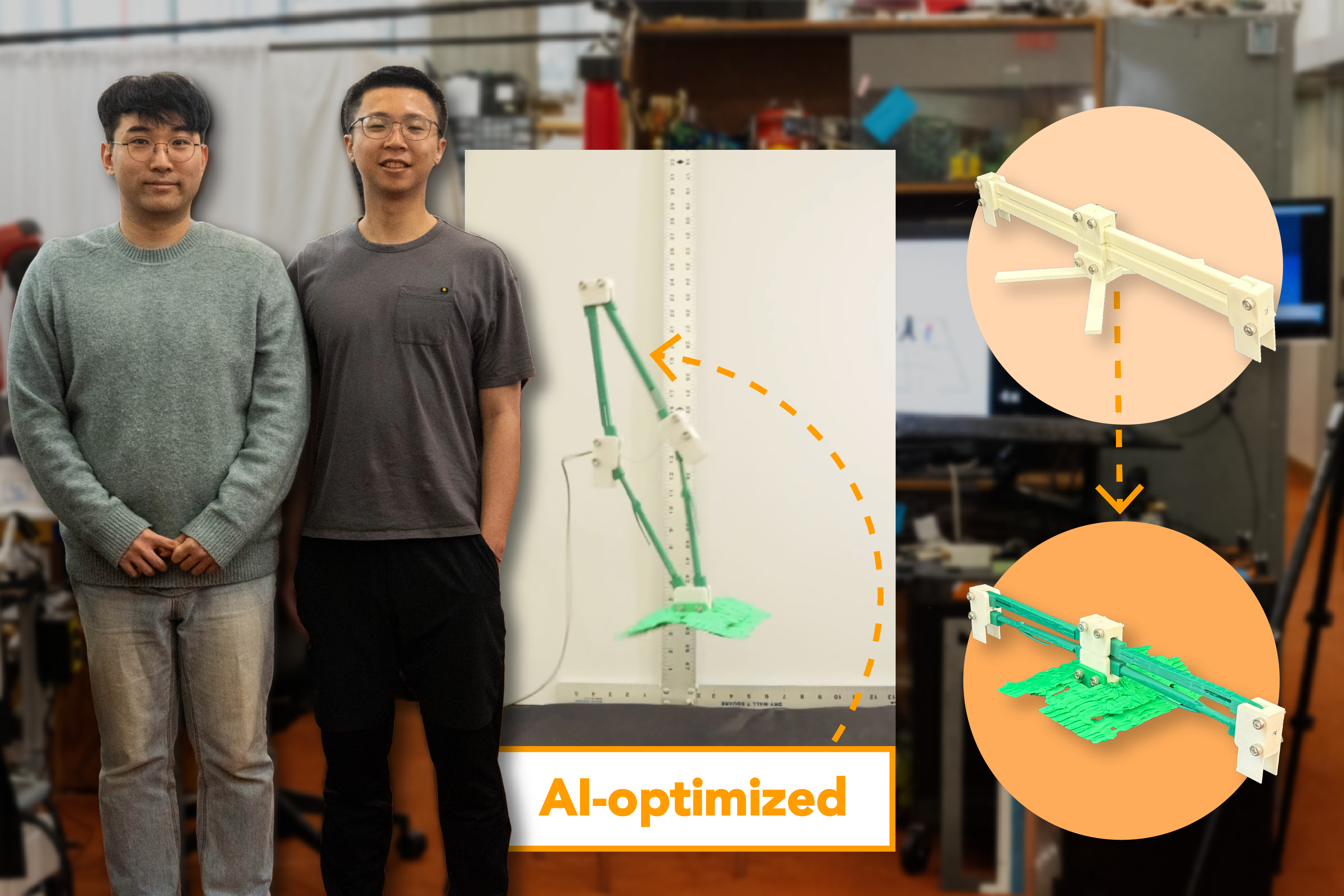
An estimated 20% of every dollar spent on manufacturing is wasted, totaling up to $8 trillion a year, more than the entire annual budget for the U.S. federal government. While industries like healthcare and finance have been rapidly transformed by digital technologies, manufacturing has relied on traditional processes that lead to costly errors, product delays, and an inefficient use of engineers’ time.

Image
PhD student Faraz Faruqi, lead author of a new paper on the project, says that TactStyle could have far-reaching applications extending from home decor and personal accessories to tactile learning tools (Credits: Mike Grimmett/MIT CSAIL).
CSAIL article

Essential for many industries ranging from Hollywood computer-generated imagery to product design, 3D modeling tools often use text or image prompts to dictate different aspects of visual appearance, like color and form. As much as this makes sense as a first point of contact, these systems are still limited in their realism due to their neglect of something central to the human experience: touch.

Image
The models were trained on a dataset of synthetic images like the ones pictured, with objects such as tea kettles or calculators superimposed on different backgrounds. Researchers trained the model to identify one or more spatial features of an object, including rotation, location, and distance (Credits: Courtesy of the researchers).
CSAIL article

When visual information enters the brain, it travels through two pathways that process different aspects of the input. For decades, scientists have hypothesized that one of these pathways, the ventral visual stream, is responsible for recognizing objects, and that it might have been optimized by evolution to do just that.