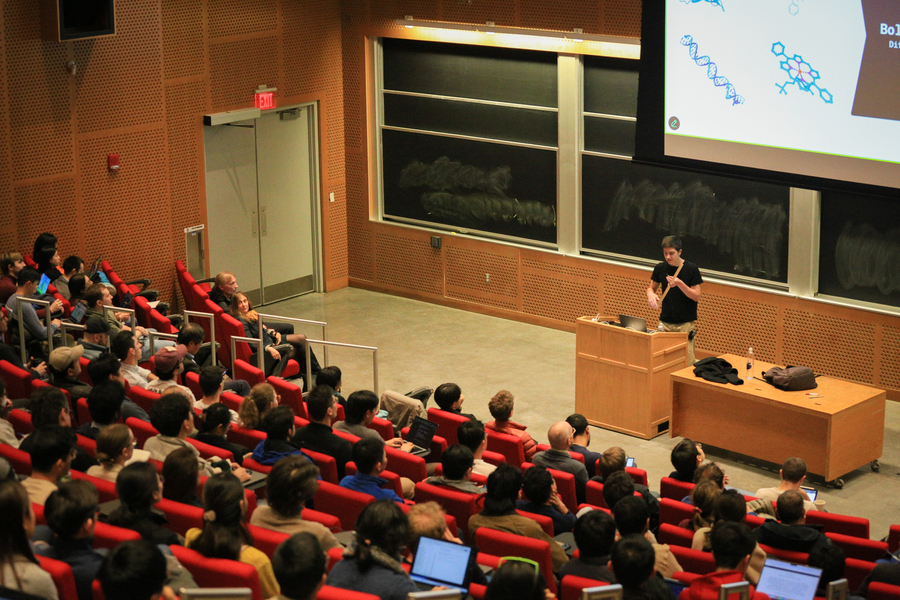
More than 300 people across academia and industry spilled into an auditorium to attend a BoltzGen seminar on Thursday, Oct. 30, hosted by the Abdul Latif Jameel Clinic for Machine Learning in Health (MIT Jameel Clinic). Headlining the event was MIT PhD student and BoltzGen’s first author Hannes Stärk, who had announced BoltzGen just a few days prior.
When the FORTRAN programming language debuted in 1957, it transformed how scientists and engineers programmed computers. Complex calculations could suddenly be expressed in concise, math-like notation using arrays — collections of values that make it easier to describe operations on data. That simple idea evolved into today’s “tensors,” which power many of the world’s most advanced AI and scientific computing systems through modern frameworks like NumPy and PyTorch.
In an MIT classroom, a professor lectures while students diligently write down notes they will reread later to study and internalize key information ahead of an exam.
What can we learn about human intelligence by studying how machines “think?” Can we better understand ourselves if we better understand the artificial intelligence systems that are becoming a more significant part of our everyday lives?
Coding with large language models (LLMs) holds huge promise, but it also exposes some long-standing flaws in software: code that’s messy, hard to change safely, and often opaque about what’s really happening under the hood. Researchers at MIT’s Computer Science and Artificial Intelligence Laboratory (CSAIL) are charting a more “modular” path ahead.
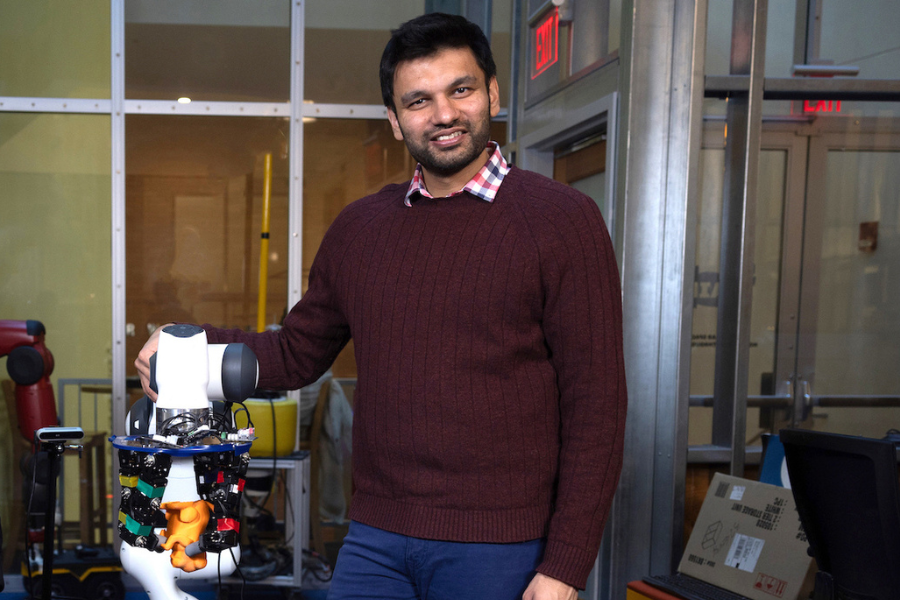
Pulkit Agrawal, MIT EECS Associate Professor and CSAIL principal investigator, has received the Toshio Fukuda Young Professional Award from the IEEE/RSJ International Conference on Intelligent Robots and Systems (IROS) for his work in “robot learning, self-supervised and sim-to-real policy learning, agile locomotion, and dexterous manipulation,” according to the organization.
The Massachusetts Institute of Technology’s Computer Science and Artificial Intelligence Laboratory (MIT CSAIL) and Pegatron Corporation today announced a landmark five-year research partnership aimed at developing the next generation of emotionally and physically intelligent robotic systems. The program, led by CSAIL Director and MIT Professor Daniela Rus and Alan Lin, Corporate Partner Lead at Pegatron, will run from 2026 to 2031 and is designed to redefine the capabilities of robots in human-centered environments.
Hal Abelson, MIT Class of 1922 Professor and CSAIL principal investigator, has received the 2025 Lifetime Achievement Award for Excellence from Open Education Global for helping make information technology more accessible worldwide. “Hal Abelson’s work promotes knowledge of all forms as a public good,” notes the organization in a public statement. “Hal’s work has focused on communities working together to advance and support knowledge.”
The degree to which someone trusts the information depicted in a chart can depend on their assumptions about who made the data visualization, according to a pair of studies by MIT researchers.
It’s hard to keep up with the ever-changing trends of the fashion world. What’s “in” one minute is often out of style the next season, potentially causing you to re-evaluate your wardrobe.