

Audrey Woods, MIT CSAIL Alliances | July 6, 2026
What if you could adjust your senses as easily as you adjust the settings on your phone? You could turn down your perception of sweetness so soda registers as less sugary or nudge your sense of temperature so a cold office feels a few degrees warmer. This might seem far-fetched, but MIT CSAIL Assistant Professor Jas Brooks is actively making this vision a reality.
“Just like you can lower volume or bump it up a little bit, what if you could do the same thing for other perceptual aspects?”
Professor Brooks joined MIT CSAIL this month as an Assistant Professor in the Department of Electrical Engineering and Computer Science, a KDD Career Development Professor in Communications and Technology, and leader of the new Perceptual Engineering Lab at MIT CSAIL. Here, they will continue to design computational interfaces that sense and modulate human perception, with a focus on what screens have mostly ignored: smell, taste, temperature, and interoception.
THE OTHER SENSES: A NEW FRONTIER
While perceptual engineering isn’t a new field—some early experiments date back to the 1960s, and there was a push in the 2000s to “make the Internet smell”—only recently have advances in both AI and neuroscience made it possible to deeply understand human senses and therefore begin to modify them. “These senses are very difficult,” Brooks says. “They’re incredibly high dimensional and hard to express, so ML and AI techniques become quite useful in this space.” As our understanding has reached the point of enabling real applications, Brooks highlights how these applications then contribute back to the acceleration of the basic sciences in a flywheel effect. “It’s going back and forth a lot, and it’s very exciting.”
During college Brooks became fixated on the idea of using technology to engineer human senses. “That’s what motivated me to do my PhD.” They went on to study at the University of Chicago under Professor Pedro Lopes, who Brooks said “took a gamble and accepted me, who was very focused on smell and taste.” Since then, Brooks has established themselves as one of the leaders in a field rapidly coming out of its infancy. Propelled by maturing technologies and the COVID pandemic, perceptual engineering has become a thriving community, one Brooks nurtures by organizing symposiums and workshops to connect researchers across specialties. “I'm obsessed with smell and taste. They're very intimate and sensual experiences that you experience every day. Everybody thinks that they're an expert in it, and in some sense, they are.” With implications in medicine, gaming, mental health, data visualization, and more, Brooks is excited to be reshaping our understanding of human perception.
BYPASSING BIOLOGY: WEARABLES FOR PERCEPTION CONTROL
So what does this actually look like? One of Brooks’ PhD projects was a device for augmented breathing worn across the septum, which could change how much air a person feels they are breathing by heating or cooling the inside of the nose in sync with each inhalation. “Adding more cold makes it feel like you’re breathing in more air, and then adding more heat makes it feel like you’re breathing in less air.” The illusion borrows from everyday physiology. “When it’s winter in Boston, you feel like you’re getting gulps of air when you go outside and breathe. Or, if you go into a sauna, it feels like it’s more difficult.” While this technology is still in its early stages, a nose clip which could adjust to your breathing in real time based on environmental or biological feedback could help people adjust their perception of temperature (stay warm in a cold office or cool on a hot day), alleviate face mask discomfort, enhance virtual or augmented reality experiences, or help with meditation or sleep. Brooks’ team is exploring medical applications for augmented breathing, such as holding off a panic attack by sensing neural signals and triggering feedback to slow down inhalations.
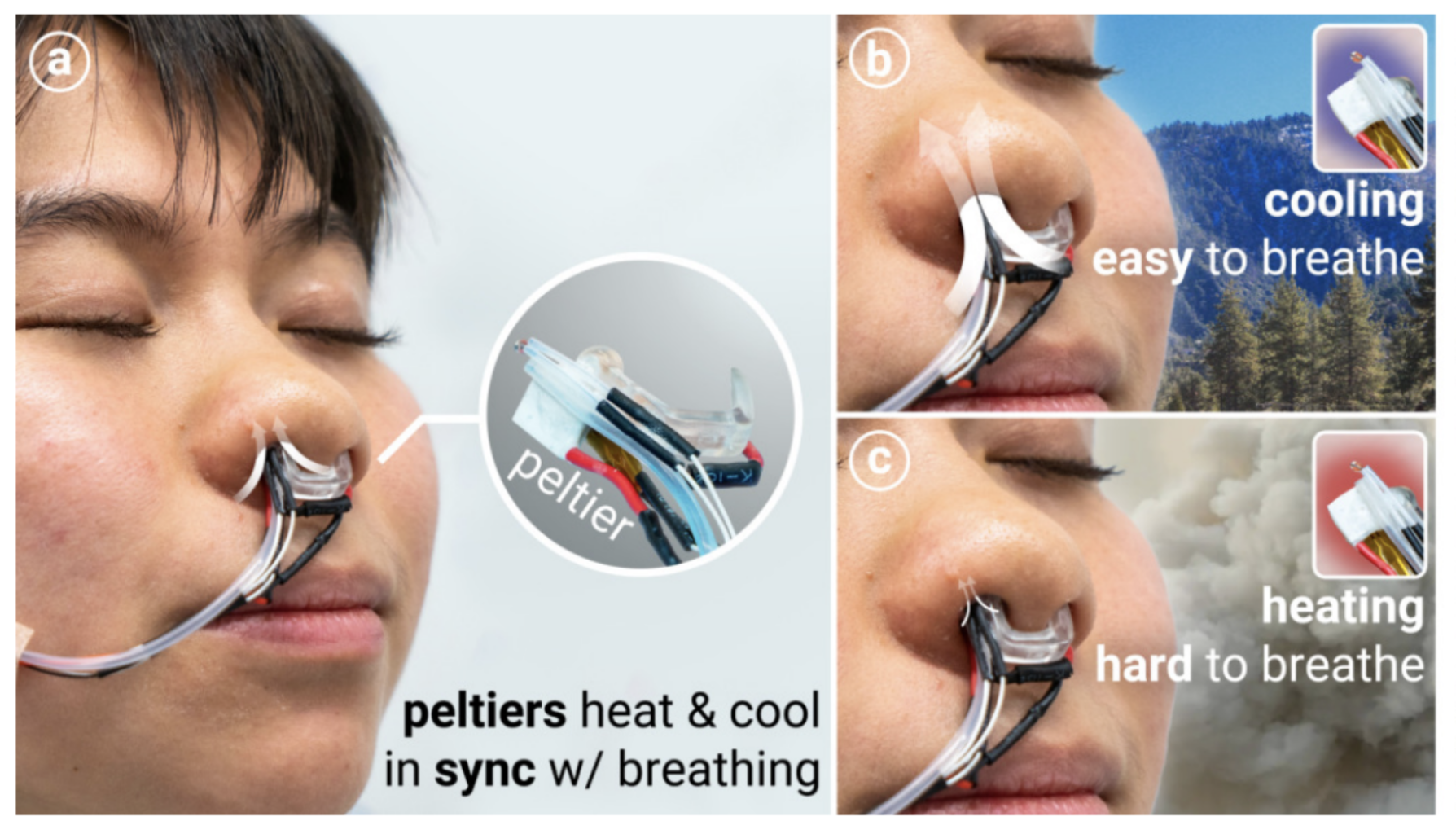
Brooks has also used nasal clip technology to experiment with stimulating the trigeminal nerve, which is “a nerve ending inside our nose that contributes to things like the spiciness of food, the pungency of smell, and the refreshingness of smell.” This device offers “stereo-smell experience” which helps users spatially locate a smell (such as a gas leak) without any prior training. Such a device could be an assistive technology for those who have lost their sense of smell as well as a novel interface for interactive haptic feedback in gaming, work environments, or general leisure.
Beyond—or rather below—the nose, Brooks has worked on taste retargeting, using chemical modulators to change the response of taste receptors and alter the taste of real food in real time.
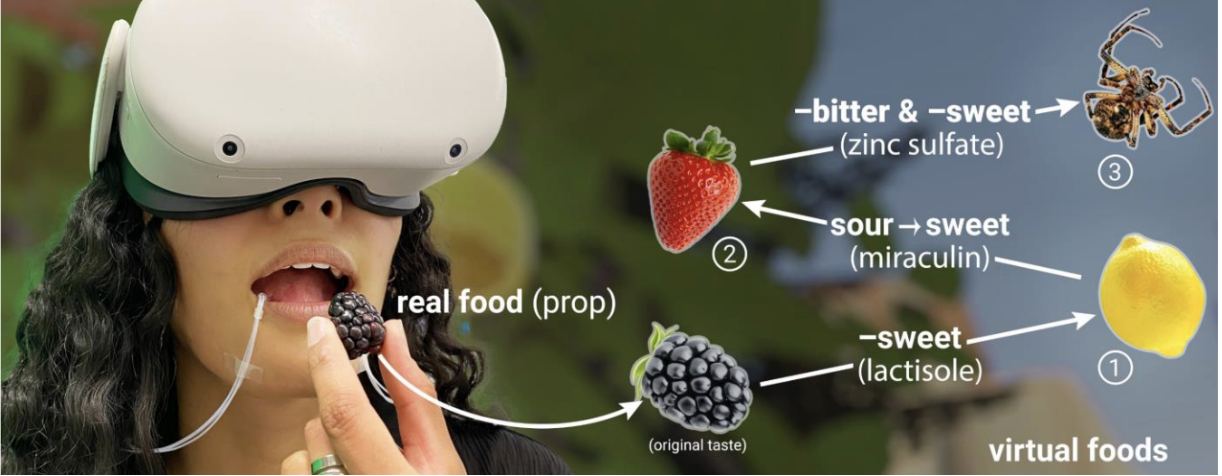
While this was tested in a VR environment, altering the taste of, for example, a blackberry to match what the user was “tasting” in the virtual game, the ability to alter taste has many other uses. Food could be made more palatable for chemotherapy patients with altered taste perception, or ultra-processed foods made less palatable for those looking to eat healthier. And this is only the beginning. “In five to ten years, I’m hoping we can do coarse-grained reproduction of smell and taste sensations.” Brooks says we’re in the Xerox PARC days of perceptual engineering, and they’re looking forward to getting to this field’s version of screens.
NEXT STEPS: CONCRETE APPLICATIONS AND BROADER POTENTIAL
As the Perceptual Engineering Lab spins up, its early work will focus on two main threads: building the foundations that don’t yet exist for this emerging field and tackling real-world problems that could reasonably be addressed with currently available technology. Brooks finds that “these two threads feed each other: the applications reveal what foundations are missing and need to be covered, and the foundations expand what applications become possible.” Unlike vision and sound, smell, taste, and interoception “have no massive datasets, standard ways of encoding a sensation, or shared models of how stimuli map to what people actually perceive.” While Brooks’ lab plans to create needed datasets, they are also focused on developing a deeper understanding of respiratory systems and creating robust prediction models.
On the application side, one project aims to apply perceptual engineering to mental health, specifically schizophrenia. Brooks describes how some people on the schizophrenia spectrum, even on medication, use tools like smart glasses, earbuds, or phone cameras for what clinicians call ‘reality testing,’ or a discreet way to check whether something they are perceiving is actually there. One simple device the group has discussed would map ambient sound to vibrations on a smartwatch, so a wearer unsure about a loud voice nearby could confirm whether it registered in the physical world. Brooks plans to work with patient advocates to document how people already do this and to co-design tools that make it easier and less conspicuous. Additionally, Brooks’ postdoc has plans to design a small, self-contained nose clip that measures the health of the nasal lining, including inflammation and neural signals, which might catch the onset of events like anxious breathing or even an allergy flare and respond by delivering antihistamines immediately and locally, potentially reducing symptoms of seasonal allergies.
A challenge in this research is the natural variation in populations. Noses are shaped very differently and each person’s sensitivity and perception of a taste or smell vary greatly due to genetic differences or physiological state. It’s extremely difficult to know if one person’s perception matches someone else’s. “That's a big next step we're looking at, and one I'm hoping to work on with one of my PhD students this fall: running larger studies and then seeing if we can build models that generalize across populations.”
What makes Professor Brooks' work so resonant is that these senses—smell, taste, touch, temperature—are not just biological functions but the fabric of shared human experience. “Smell is highly negotiated. Two people might smell the same odor, and their first instinct is to talk about it—'this reminds me of this,' and the other person says, 'oh, it reminds me of something else.' And they converge on an understanding of the odor together.” It is that convergence between people, disciplines, and experiences that defines both the challenge and the promise of perceptual engineering. “There are so many aspects of smell, taste, and interoception that we don't understand, and that's what makes me excited about creating new tools for interacting with it, measuring it, or modifying how it functions. That's really what gets me out of bed every day and gets me excited to work with students."
Learn more about Professor Brooks on their website.