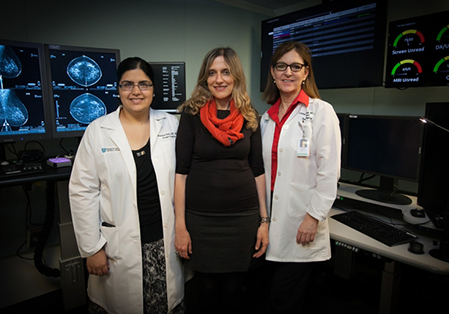
Researchers from MIT and Massachusetts General Hospital have developed an automated model that assesses dense breast tissue in mammograms — which is an independent risk factor for breast cancer — as reliably as expert radiologists.
We demonstrate how a sequence model and a sampling-based planner can influence each other to produce efficient plans and how such a model can automatically learn to take advantage of observations of the environment.
Researchers from MIT’s Computer Science and Artificial Intelligence Laboratory (CSAIL) have come up with a way to get a better handle on this understanding of complex motion.
The new system uses an algorithm that can take 2-D videos and turn them into 3-D-printed “motion sculptures” that show how a human body moves through space.
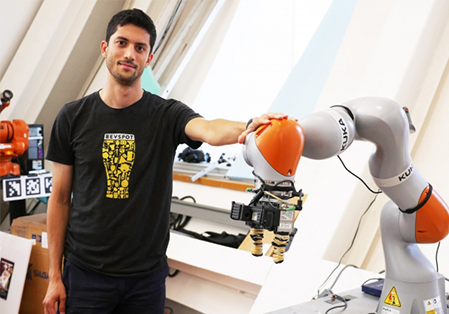
We present Dense Object Nets, which build on recent developments in self-supervised dense descriptor learning, as a consistent object representation for visual understanding and manipulation.